What a smart scale taught me about getting older, getting stronger, and finally making peace with my body.
I’m turning 60 next month, and there is something I don’t think I could have said at 30, 40, or even 50: for the first time I can ever remember, I am not at war with my body.
I feel good in my body. My joints feel good. I have energy and enthusiasm, and I feel strong. Most importantly, I finally have a much better understanding of what my body needs as I get older.
I wish I had known this in my 20s.
It Started with an F
I already owned a smart scale. My old scale gave me a Body Score of 91, which felt like a pretty good grade to me.
Then I upgraded to a Hume scale because I wanted more information about what was actually happening with my body. I wasn’t particularly interested in my weight; I wanted to understand what was underneath that number.
And Hume gave me an F for body composition. Rude. I was offended. I thought I looked good. Since I’m someone who likes to get a good grade, instead of dismissing the result I went down the rabbit hole.
I Discovered That the Number on the Scale Isn’t the Point
Body composition asks a much more interesting question: What is that weight actually made of? How much is fat? How much is lean tissue? How much is muscle? And where is the fat?
That distinction was meaningful to me as I moved through menopause and got older. I wasn’t unhappy with my weight, but the same weight I had lived at for years didn’t look or feel the same on my body anymore. I could accept that as part of aging, or I could learn what was happening and figure out what I could influence. I chose to learn.
A Year of Paying Attention
Once I understood what I was looking at, I stopped focusing on a single number and started looking at the bigger picture—and the trend.
Over the past year, my body composition changed dramatically. I reduced body fat while increasing lean mass and skeletal muscle. My visceral fat also moved in a positive direction.
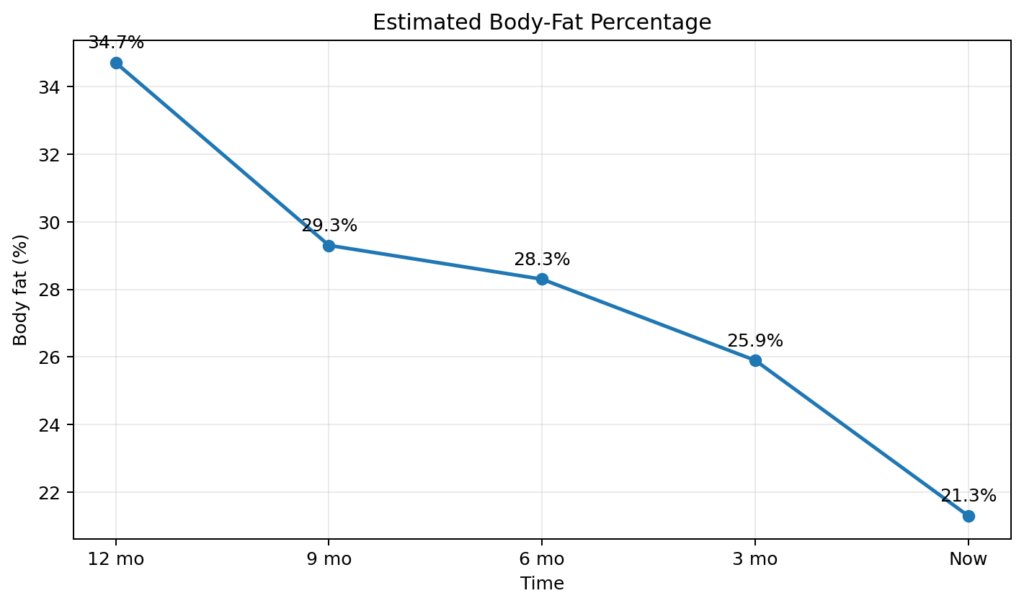
The numbers are not laboratory measurements so I don’t treat them as gospel. Smart scales use bioimpedance, and readings can be affected by hydration, timing and other factors. I use mine to watch my own trends over time, rather than obsessing over an individual reading. That’s what changed for me. The scale gave me questions.
The second chart makes the bigger point even clearer: this wasn’t simply about losing fat. I was interested in what was happening to the rest of my body, too.
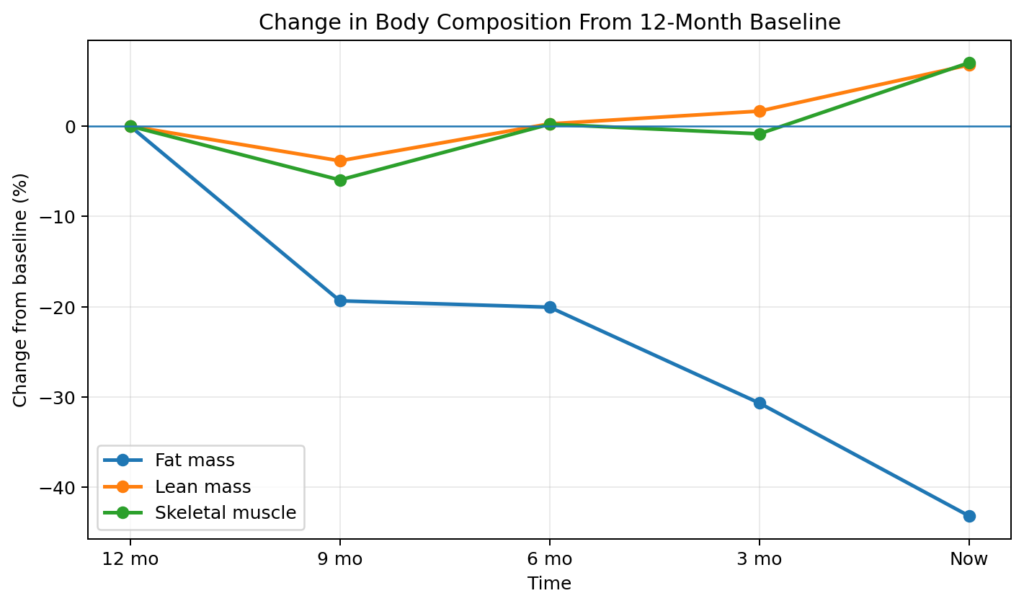
That is the story worth telling: not a smaller body, but a different composition.
The Rabbit Hole Changed the Way I Trained
Once I understood what I was looking at, I started thinking differently about what I could actually do. Over the last three or four months, I became much more intentional about protein, started taking creatine consistently, and deliberately challenged myself with more resistance in my Pilates practice.
I wasn’t doing more exercise. I was thinking about whether I was giving my muscles enough of a reason to maintain themselves and, ideally, grow.
I’ve spent decades teaching and practicing Pilates, but I’m looking at strength differently now. As we get older, strength isn’t simply about how our bodies look. It’s about what they allow us to do—carry a suitcase through an airport, get up off the floor, hike, travel, maintain our balance and keep saying yes to the things we want to do.
I also started paying more attention to hydration. I already drank a lot of water, so my answer wasn’t simply to drink more. I went back to using LMNT, which I’d used before, and started thinking about hydration as water + electrolytes + consistency rather than simply trying to force down more plain water.
None of these changes happened because a smart scale gave me a prescription. It simply made me curious enough to start asking better questions.
Somewhere Along the Way, My Goal Changed
For years, the goal was some version of smaller. Now I don’t want to be smaller. If I’m completely honest, I would be perfectly happy maintaining the size I’ve lived at for years if the composition underneath it were different. I want more muscle, strong bones, good balance, energy and the physical capacity to keep doing the things I love. My biggest surprise is that I no longer feel like I have to fight my body to get there.
From an F to a B+
Today, Hume has me at a B+ for body composition. And strangely enough, that B+ feels better to me than an A ever could.
Because I studied. I learned what body composition actually means, learned that muscle matters, paid more attention to protein, started taking creatine consistently, challenged myself with more resistance and became more thoughtful about hydration. I didn’t overhaul my life overnight, and I certainly didn’t do everything perfectly. I just kept making better-informed choices and paying attention to what happened next.
The goal isn’t perfection. It’s progress.
That’s the thing I most wish I’d understood when I was younger. My body was never a test I was supposed to ace. It was something I was supposed to understand, take care of and keep learning from.
I’m turning 60 next month, and for the first time I can ever remember, I’m not at war with my body. I don’t need it to be smaller or younger or perfect. I want it to be strong, capable and healthy, and I want to keep learning what it needs from me as I move through the next chapter.
So yes, I got an F. Today I’m a B+, and I’m pretty pleased with that. Because the B+ isn’t a measure of perfection. It’s proof that I made progress.
Continue Your Pilates Journey
At Evolution Pilates, we believe Pilates is a structured, intentional and effective workout. Our classical approach builds strength, stamina, stability and stretch through a system designed to work the whole body. Because Pilates is a workout. And your breath is part of it.
Whether you’re new to Pilates or ready to deepen your practice, we’d love to welcome you to our studio in Port Washington, Long Island.
Ready to feel the difference? Book your session and experience the system the way it was designed to work.
Affiliate disclosure: This post contains affiliate links. If you purchase through my link, I may receive a commission at no additional cost to you. I only recommend products I personally use or believe are worth sharing.